

High Accuracy vs. Battery Life: How Tupaia’s IoT Mode Solves the Ultimate GNSS Dilemma
High Accuracy vs. Battery Life: How Tupaia’s IoT Mode Solves the Ultimate GNSS Dilemma
When deploying battery-operated IoT devices in the field, such as asset trackers, environmental sensors, or machinery monitors, hardware engineers and fleet managers have historically been forced to make a painful compromise between accuracy and battery longevity.
If you need your devices to maintain a long operational lifespan on a strict power budget, standard GNSS positioning is typically the default choice. However, standard GNSS often leaves you with an accuracy bottleneck of several meters. On the other hand, if your application demands sub-meter accuracy or even centimeter-level precision, the industry standard has long been RTK (Real-Time Kinematic).
The catch is that RTK is highly power-consuming compared to standalone GNSS. In addition to its heavy processing requirements, it demands simultaneous, continuous cellular connectivity to stream correction data in parallel with the GNSS receiver until convergence is achieved. For a battery-operated device relying on a strict power budget, this operational mode is a major drain on lifetime.
At Tupaia, we designed a solution that eliminates this compromise. We are excited to introduce Tupaia’s proprietary IoT Mode, a cloud-powered paradigm shift that unlocks high-precision positioning for battery-operated IoT devices without compromising their field life.
The Low-Power Challenge of Sporadic Operation
Consider the real-world environments where tracking requires strict precision
* Railroad Depot Yards: Tracking rolling stock assets requires track-level differentiation. If your system cannot distinguish between two parallel tracks, it translates to operational friction. This demands sub-meter accuracy.
* Landfills and Mining: Sensing subtle soil movements to prevent structural failures requires precision down to the centimeter.
In these use cases, devices rely on sporadic operation, waking up perhaps once an hour or a few times a day to report. Standard GNSS receivers starting from this "cold-start" state take along time to calculate an accurate position. The longer the chips remain active, the faster the battery drains.
Enter Tupaia’s IoT Mode
Tupaia’s cloud-powered positioning platform completely reengineers this workflow. Instead of using power-consuming, complex receivers or relying on inefficient operational schemes that require receiving and processing RTK streams locally, our IoT mode shifts the processing to the cloud.
When a device wakes up, our cloud orchestrates the exact, optimized duration the GNSS and cellular chips need to be turned on. The device collects just the right amount of raw GNSS data required for the target precision, transmits it instantly, and immediately drops back into an idle sleep state.
Because the cloud handles the heavy arithmetic and applies Tupaia's advanced algorithms, the hardware on the ground consumes a mere fraction of the power it normally would. Once the cloud computes the high-precision coordinates, it provides the data to your management application or server via a dedicated, developer-friendly third-party API.
Evaluating the Performance: 100 Cold-Starts
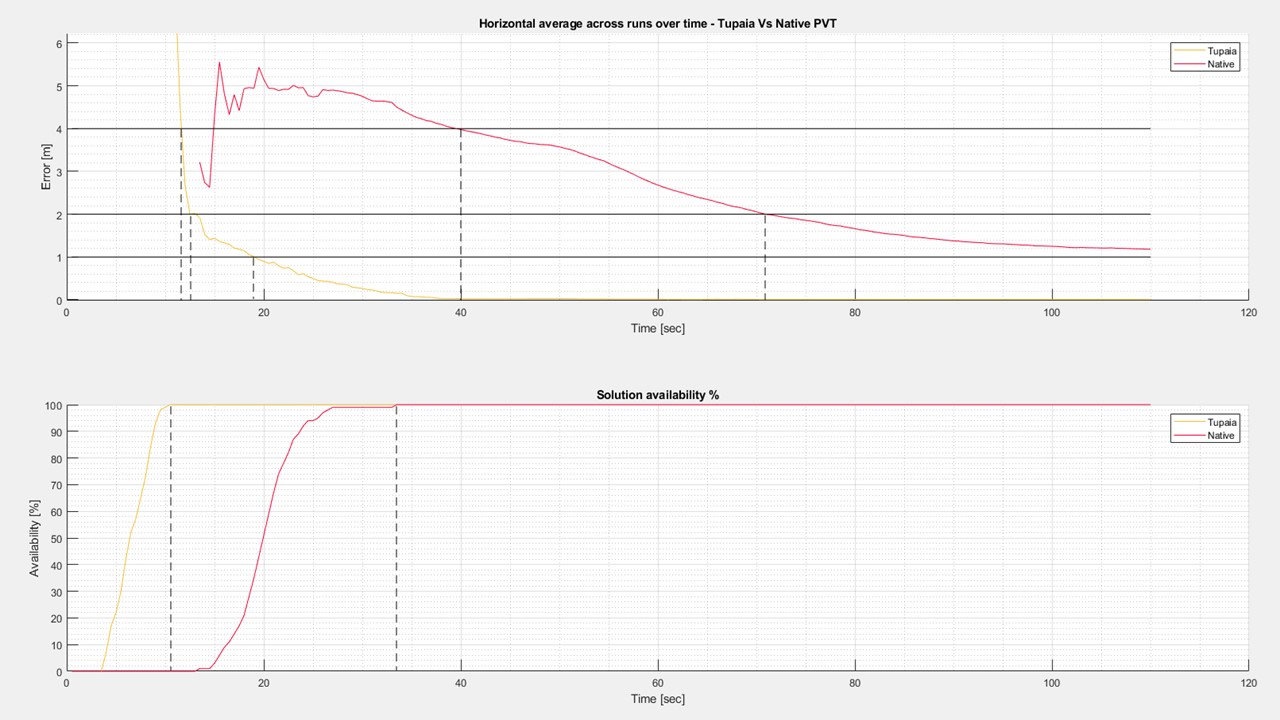
To evaluate the performance of our technology under rigorous conditions, we conducted a benchmark of 100 cold-starts using a standard dual-frequency L1/L5 GNSS receiver. Crucially, this was a standard performance receiver without RTK capabilities. We compared its standalone performance directly against its performance when paired with Tupaia's IoT Mode.
The results demonstrate a clear operational advantage:
* 60% Reduction in TTFF1: Time to First Fix (TTFF) was slashed by 60%, meaning the receiver took drastically less time to reach the first calculated position. This is an important metric in GNSS receiver performance, directly correlating to power savings. This improvement shows that Tupaia's IoT mode can potentially save significant battery life even for less demanding use cases where an accuracy of a few meters is perfectly sufficient.
* Rapid Convergence: The time required to converge to an accuracy of 4meters and 2 meters was reduced by 70% and 80% respectively.
* Sub-Meter Mastery in Seconds: Tupaia’s IoT mode guided the standard receiver to sub-meter accuracy in just 19 seconds. By comparison, the standalone GNSS receiver failed to reach sub-meter accuracy even after over 100 seconds of continuous operation.
Unlocking a New Frontier of Use Cases
By removing the power barrier to high-precision location data, Tupaia’s IoT mode is opening up entirely new applications across logistics, agriculture, construction, and smart infrastructure. Industrial operators no longer have to deploy massive battery packs or compromise on data frequency just to keep devices alive in the field.
With Tupaia, you can finally deploy low-cost, lightweight IoT asset trackers that maintain a prolonged operational lifetime while delivering the sub-meter or centimeter-level precision your business operations demand.
(1) In this blog we refer to TTFF as the time for the first positioning solution output.